
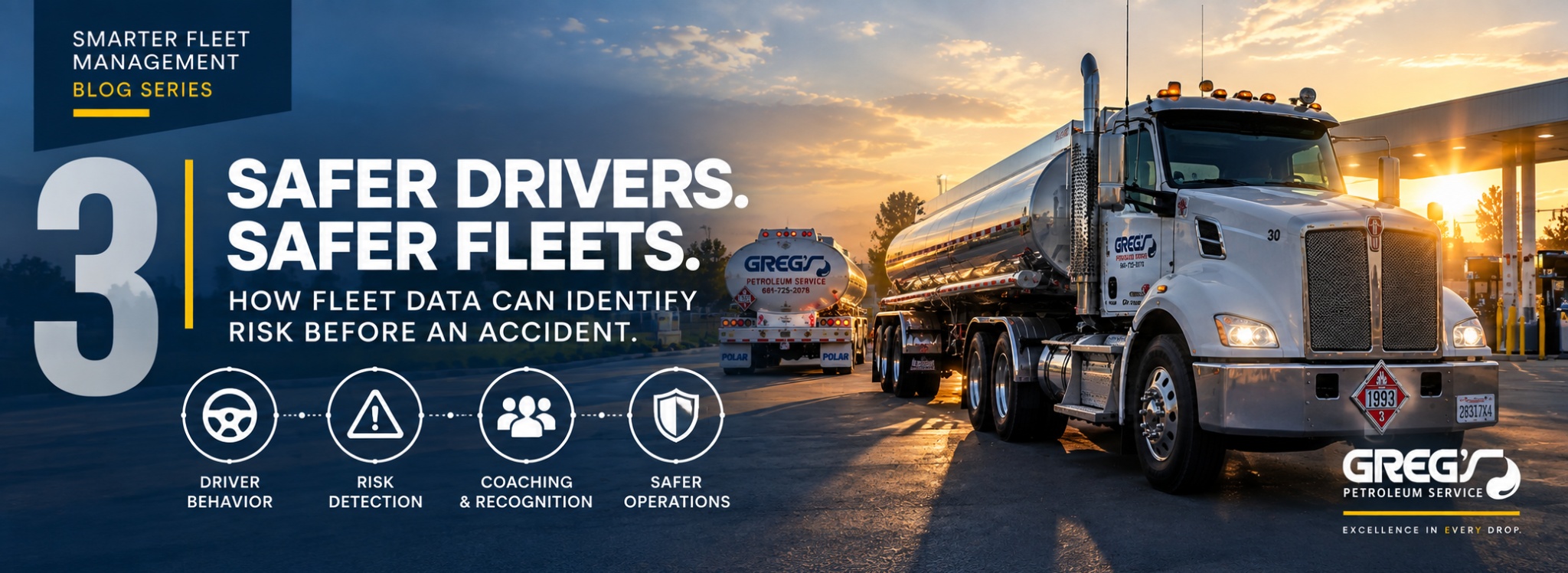
How Fleet Data Can Help Identify Risk Before an Accident
When it comes to fleet safety, the best accident is the one that never happens.
But traditional safety programs can easily become reactive.
An incident happens. Someone reviews what went wrong. A driver receives additional training. Policies may change.
All of those steps can be valuable—but they happen after the event.
What if fleet managers had more opportunities to identify risk before an accident occurred?
That’s one of the reasons Greg’s Petroleum Service has implemented Samsara technology in our own fleet.
From Reaction to Prevention
One of the challenges Samsara identifies with traditional safety programs is a reactive approach that focuses on incidents rather than prevention. The company also points to challenges such as limited driver buy-in, difficulty coaching at scale and a lack of clear prioritization of higher-risk behaviors.
Connected fleet technology changes the amount of information available.
Rather than only knowing that an accident happened, managers can potentially identify behaviors and trends leading up to risk.
What Can the Technology See?
Quite a bit.
Samsara lists more than 40 AI detections covering a wide variety of conditions and behaviors.
They include potential collision risks such as speeding, following distance and lane departure, distraction risks such as mobile usage and inattentive driving, and harsh-driving events including acceleration, braking and turning. The platform can also identify contextual conditions including construction zones, wet roads, rain, fog, nighttime driving and congestion.
That context matters.
A single hard-braking event doesn’t tell an entire story.
Maybe a vehicle suddenly pulled in front of the truck.
Maybe traffic stopped.
Maybe the driver was following too closely.
The event provides a starting point. The surrounding data helps provide context.
Look for Patterns, Not Just Events
One of the more useful aspects of modern safety technology is the ability to prioritize information.
Fleet managers don’t necessarily need another dashboard containing hundreds of alerts. They need to know what deserves attention.
Samsara’s system assesses risk using factors such as event severity—including g-force and speed—event frequency, safety score, previous events and coaching, driver tenure, total drive time, weather, road conditions and time of day.
That can help distinguish between an isolated event and a recurring behavior.
Safety Data Should Lead to Coaching
The purpose of identifying a behavior shouldn’t simply be to catch someone doing something wrong.
It should create an opportunity to improve.
If a driver repeatedly follows too closely, brakes aggressively or experiences another recurring safety event, managers have specific information they can use during coaching.
Instead of:
“You need to drive safer.”
The conversation can become much more specific:
“We’re seeing a pattern here. Let’s talk about what’s happening and how we can improve it.”
That’s a much more actionable conversation.
Don’t Forget to Recognize What’s Going Right
There’s another side of driver data that’s equally important: recognizing safe behavior.
Samsara’s platform includes defensive driving among its positive behaviors and offers driver recognition and coaching tools.
If technology is only used to point out mistakes, it’s easy to understand why drivers might view it negatively.
Used differently, the same technology can help recognize employees who consistently demonstrate safe habits.
Technology Doesn’t Replace Good Drivers
A camera, sensor or algorithm doesn’t make a fleet safe by itself.
People do.
Technology provides information. Fleet managers and drivers determine what happens with that information.
At Greg’s Petroleum Service, Samsara gives us another tool to help understand what’s happening on the road and identify opportunities to improve our operation.
For any business operating trucks or service vehicles, that type of visibility can help shift the safety conversation from “What happened?” to a much more valuable question: “What can we do before something happens?”
Want to learn more about the safety and fleet-management technology Greg’s Petro is using? Contact your Greg’s Petro lubricants supplier to learn more about Samsara.